


Finding trustworthy information about collagen supplements can feel confusing, especially when you want radiant skin and flexible joints to match your busy routine. As the body’s most abundant protein, collagen forms specialised triple-helix structures that give strength and flexibility to skin, bones, and cartilage. With so many types and supplement sources on offer in the United Kingdom, understanding what each does will help you make confident, targeted choices for lasting beauty and movement support.
Table of Contents
- What Are Collagen Types And How They Work
- Key Differences: Type I, II, And III Collagen
- Sources Of Collagen In Supplements
- Benefits For Skin, Joints, And Fitness
- How To Choose The Right Collagen Type
- Common Myths And Safety Considerations
Key Takeaways
| Point | Details |
|---|---|
| Collagen Types Matter | Understanding different collagen types is essential for targeting specific health goals, such as skin health or joint support. |
| Age-Related Decline | Collagen production decreases with age, particularly affecting women in their late twenties to thirties, hence supplementation may be beneficial. |
| Source Selection | The choice of collagen source—bovine, marine, or chicken—can significantly impact the supplement’s effectiveness and health benefits. |
| Misconceptions | Common myths about collagen supplementation, such as assuming all supplements are the same, can mislead consumers; individual products vary significantly in quality and effectiveness. |
What Are Collagen Types and How They Work
Collagen is the body’s most abundant protein, serving as a critical structural foundation for our tissues. Far from being a single uniform substance, collagen represents a complex family of proteins with remarkable diversity and specialised functions.
At its core, collagen is a protein with a fascinating molecular architecture. Native collagen molecules form intricate triple-helix structures that provide extraordinary mechanical strength and support to our body’s connective tissues. These molecular structures are not just passive scaffolding, but dynamic frameworks that enable cellular function and tissue repair.
The collagen protein family comprises multiple distinct types, each with unique characteristics:
- Type I Collagen: Predominant in skin, bones, and tendons
- Type II Collagen: Primary component in cartilage and joint tissues
- Type III Collagen: Found in skin, muscles, and blood vessels
- Type IV Collagen: Critical for basement membranes and cellular foundations
Collagen molecules assemble into complex fibrils and fibres that provide remarkable strength, flexibility, and structural integrity across different bodily systems. These protein networks are not static but dynamically adapt to support tissue health, repair, and regeneration.
Interestingly, collagen production naturally declines with age. For women in their late twenties and thirties, this reduction becomes increasingly significant, potentially impacting skin elasticity, joint health, and overall tissue resilience. Understanding these nuanced collagen types allows for more targeted nutritional and lifestyle strategies.
Pro tip: Consider tracking your collagen intake and supplementation based on your specific health goals, whether that’s supporting skin radiance, joint mobility, or overall connective tissue health.
Key Differences: Type I, II, and III Collagen
Type I Collagen represents the most abundant protein in the human body, playing a crucial role in maintaining structural integrity across multiple tissue systems. Approximately 90% of the body’s collagen is type I, making it a fundamental building block for numerous physiological processes.
The unique characteristics of each collagen type distinguish their functional roles:
-
Type I Collagen:
- Provides strength to bones, skin, tendons, and ligaments
- Forms dense, tightly packed fibers
- Critical for wound healing and tissue repair
-
Type II Collagen:
- Primarily located in cartilage tissues
- Enables joint movement and shock absorption
- Helps resist compressive forces
-
Type III Collagen:
- Abundant in skin, blood vessels, and internal organs
- Often co-exists with type I collagen
- Supports elasticity and structural flexibility
Understanding these distinctions becomes particularly important for women in their late twenties and thirties, when natural collagen production begins to decline. Each collagen type contributes uniquely to maintaining tissue health, with type I providing robust structural support, type II supporting joint mobility, and type III ensuring tissue elasticity.

These collagen variants are not interchangeable; they serve specific biological functions that are critical for maintaining overall physiological performance. The intricate molecular differences between these types determine their precise roles in supporting our body’s complex systems.
For a concise overview, see how collagen types contribute distinctly to different health benefits:
| Collagen Type | Main System Supported | Most Notable Effect | Typical Age Impact |
|---|---|---|---|
| Type I | Skin, bone, tendons | Structural strength | Declines after 25 |
| Type II | Cartilage, joints | Shock absorption | Affects joint health |
| Type III | Vessels, organs, muscles | Tissue elasticity | Reduces skin flexibility |
Pro tip: Consider consulting a nutritional specialist to develop a personalised collagen supplementation strategy that targets your specific health and wellness goals.
Sources of Collagen in Supplements
Collagen supplements derive from diverse biological sources, each offering unique characteristics and potential health benefits. Collagen sources typically include bovine, marine, and chicken origins, with each providing distinct collagen type profiles that target specific physiological needs.
The primary sources of collagen supplements include:
-
Bovine Collagen:
- Derived from grass-fed cattle
- Rich in types I and III collagen
- Supports skin and connective tissue health
- Most widely available supplement source
-
Marine Collagen:
- Extracted from fish skin and scales
- Predominantly contains type I collagen
- Smaller molecular size for potentially better absorption
- May have higher purity but potential contamination risks
-
Chicken Collagen:
- Sourced from chicken cartilage and bones
- Concentrated in type II collagen
- Particularly beneficial for joint health and cartilage support
Selecting the right collagen source requires understanding your specific health objectives. Supplement formulations differ significantly in their collagen type profiles, enabling targeted approaches for beauty, joint mobility, or fitness recovery.
Women in their late twenties and thirties should pay special attention to the source and quality of their collagen supplements. The molecular composition and origin can dramatically influence the supplement’s effectiveness in supporting skin elasticity, joint function, and overall tissue health.
To help clarify how various collagen sources match different wellness goals, here’s a quick reference table:
| Supplement Source | Dominant Collagen Types | Ideal Health Target | Unique Consideration |
|---|---|---|---|
| Bovine | Types I & III | Skin & tissue health | Widely available, grass-fed options |
| Marine | Type I | Skin elasticity | Higher purity, smaller molecules |
| Chicken | Type II | Joint & cartilage | Focused joint support, allergen risk |
Pro tip: Consult with a nutritional specialist to determine the most suitable collagen supplement source based on your individual health profile and specific wellness goals.
Benefits for Skin, Joints, and Fitness
Collagen supplementation offers comprehensive health benefits targeting multiple physiological systems. Clinical reviews demonstrate significant positive effects across skin health, joint function, and fitness performance, making it a versatile nutritional strategy for women seeking holistic wellness.
The specific benefits across different health domains include:
Skin Health:
- Improves skin elasticity
- Reduces visible signs of aging
- Enhances natural hydration
- Supports collagen density and structure
- Promotes smoother, more resilient skin texture
Joint Function:
- Reduces osteoarthritis symptoms
- Supports cartilage health
- Decreases joint discomfort
- Improves overall joint flexibility
- Aids tissue repair mechanisms
Fitness Performance:
- Supports muscle strength recovery
- Accelerates post-exercise tissue repair
- Reduces exercise-related inflammation
- Enhances connective tissue resilience
- Promotes faster muscle regeneration
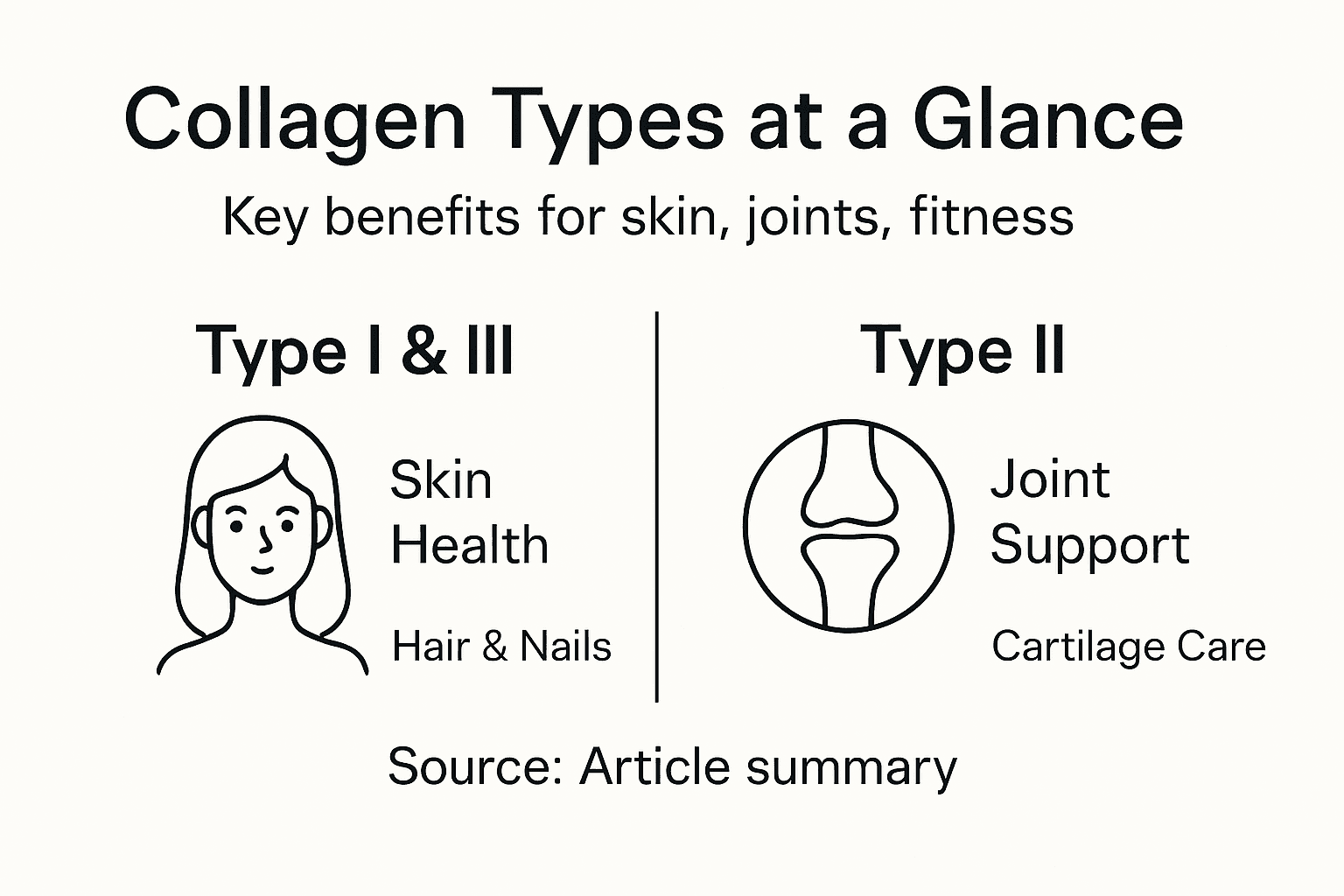
Different collagen types contribute uniquely to these health outcomes, with types I and III particularly supporting skin firmness and type II targeting joint cartilage health. The biochemical mechanisms involve anti-inflammatory, antioxidant, and tissue remodeling processes that work synergistically to support overall physiological function.
Women in their late twenties and thirties can especially benefit from targeted collagen supplementation, as natural collagen production begins to decline during this period. Understanding these nuanced benefits allows for more strategic nutritional interventions tailored to individual health objectives.
Pro tip: Consider tracking your body’s response to collagen supplementation by maintaining a wellness journal that documents changes in skin texture, joint comfort, and exercise recovery.
How to Choose the Right Collagen Type
Selecting the optimal collagen supplement requires a strategic approach tailored to your specific health objectives. Choosing collagen depends critically on understanding your individual wellness goals, whether targeting skin rejuvenation, joint mobility, or fitness recovery.
Key considerations for selecting the right collagen type include:
Health Goal Alignment:
-
Skin Health & Anti-Aging:
- Prioritise types I and III collagen
- Recommended sources: Bovine or marine collagen
- Targets skin elasticity and reducing visible aging signs
-
Joint Support & Mobility:
- Focus on type II collagen
- Recommended source: Chicken cartilage
- Supports cartilage health and reduces joint discomfort
-
Overall Tissue Resilience:
- Consider combined collagen types
- Look for hydrolysed peptide formulations
- Supports multiple physiological systems
Product selection requires careful evaluation of source quality and bioavailability, with key factors including third-party testing, molecular size, and purity. Women in their late twenties and thirties should prioritise high-quality supplements that match their specific wellness objectives.
Avoid supplements with unnecessary fillers or low-quality sources. Opt for trusted brands that transparently share their collagen sourcing, processing methods, and specific type concentrations. The most effective supplements will provide targeted nutrition aligned with your individual health needs.
Pro tip: Consult with a nutritional specialist to develop a personalised collagen supplementation strategy that precisely matches your unique health profile and wellness goals.
Common Myths and Safety Considerations
Collagen supplementation has attracted numerous misconceptions that can mislead consumers about its actual benefits and safety profile. Clinical evidence reveals critical insights into collagen supplement realities, challenging popular myths and providing clarity on their true physiological impact.
Common myths about collagen supplements include:
Widespread Misconceptions:
-
Myth: Collagen supplements are directly absorbed as whole molecules
- Reality: Collagen breaks down into amino acids and peptides
- Digestive processes transform supplement components
-
Myth: All collagen supplements are identical
- Reality: Different sources and types have unique properties
- Molecular structure and origin significantly impact effectiveness
-
Myth: Consuming collagen instantly rebuilds tissue
- Reality: Supports biological processes, does not directly reconstruct tissues
- Requires consistent supplementation and overall nutritional support
Safety considerations emphasise choosing high-quality products free from contaminants, with particular attention to potential allergens and source purity. Marine collagen, for instance, may carry risks related to ocean pollution, necessitating careful selection and verification.
Consumers should approach collagen supplementation with informed scepticism, recognising that while generally safe, individual responses can vary. Consulting healthcare providers becomes crucial, especially for individuals with pre-existing medical conditions or specific allergenic concerns.
Pro tip: Always verify supplement quality through third-party testing and consult healthcare professionals before starting any new nutritional regimen.
Unlock Your Best Skin, Joints, and Fitness with Targeted Collagen Support
Understanding the differences between collagen types is key to tackling common challenges like declining skin elasticity, joint discomfort, and slower fitness recovery. Whether you seek to enhance structural strength with type I collagen, support joint mobility with type II, or improve tissue elasticity with type III, choosing the right supplement matters. Women in their late twenties and thirties especially need a solution that recognises these unique collagen roles and their impact on wellness.
Discover how KUDU Nutrition’s 20g Collagen Protein Supplements provide a powerful, high-quality source of collagen designed to match your specific beauty and joint health goals.

Take control of your collagen intake with KUDU Nutrition’s premium liquid collagen sachets that combine superior collagen content with trusted quality certifications. Designed for health-conscious individuals and athletes alike, our supplements support enhanced skin vitality, improved joint comfort, and accelerated recovery. Begin your personalised collagen journey today by exploring KUDU Nutrition | 20g Collagen Protein for Performance & Recovery and secure your pack now at https://kudunutrition.com/products/20g-collagen-protein-14-pack. Empower your wellbeing with collagen tailored to your needs.
Frequently Asked Questions
What are the main types of collagen and their functions?
Collagen primarily consists of Type I, II, and III. Type I is found in skin, bones, and tendons, providing structural strength. Type II is mainly in cartilage, aiding joint movement and shock absorption. Type III supports skin, muscles, and blood vessels, contributing to elasticity and flexibility.
How do I choose the right collagen supplement for my needs?
Selecting the right collagen supplement depends on your health goals. For skin health, consider Type I and III from bovine or marine sources. For joint support, opt for Type II from chicken cartilage. For overall tissue resilience, a product combining multiple collagen types may be beneficial.
Are there any myths about collagen supplements that I should be aware of?
Yes, common myths include the belief that collagen supplements are directly absorbed as whole molecules and that all collagen supplements are the same. In reality, collagen is broken down into amino acids during digestion, and different sources and types possess unique properties and benefits.
What benefits can I expect from collagen supplementation for my skin and joints?
Collagen supplementation can improve skin elasticity, reduce signs of ageing, enhance hydration, and support overall skin texture. For joints, it may reduce discomfort, support cartilage health, and improve flexibility, making daily activities more comfortable.