

TL;DR:
- Collagen influences cell signaling, hormone activity, and metabolic regulation beyond structural roles.
- Collagen peptides can improve insulin sensitivity, fat oxidation, and lipid profiles through key metabolic pathways.
- Evidence in humans is modest and variable; consistent use with proper dosage and co-factors is recommended.
Most people reach for collagen because they want better skin or less achy knees. Fair enough. But collagen’s influence runs considerably deeper than that. As the most abundant protein in the human body, it plays active roles in cell signalling, hormone activity, and metabolic regulation that rarely make it onto a supplement label. Recent research has started connecting collagen peptides to insulin sensitivity, fat oxidation, and lipid profiles, shifting the conversation well beyond beauty. This article breaks down the science, separates the animal studies from the human evidence, and gives you a practical framework for using collagen to support your whole-body health.
Table of Contents
- What is collagen and why does it matter for metabolism?
- How collagen peptides impact glucose and fat metabolism
- What does the evidence really say? Rodents, humans, and the nuances
- The real-world benefits: Metabolism, joint, and beauty outcomes you can expect
- How to use collagen for metabolism: Practical tips and caveats
- The uncomfortable truths: What most guides don’t tell you about collagen and metabolism
- Find your collagen fit: Targeted supplements for your metabolic and beauty goals
- Frequently asked questions
Key Takeaways
| Point | Details |
|---|---|
| Collagen benefits extend beyond skin | Collagen influences not just appearance but key metabolic and systemic health pathways. |
| Human and animal results differ | Rodent studies show dramatic effects; human evidence is promising but more subtle or mixed. |
| Dosing and synergy make a difference | Evidence supports 10-20g hydrolysed collagen daily, especially with vitamin C or D for best results. |
| Realistic expectations matter | You can expect steady improvements but not overnight metabolic transformations. |
| Quality and consistency are key | Choose premium, well-formulated products for maximum benefits and practical results. |
What is collagen and why does it matter for metabolism?
Collagen makes up roughly 30% of all protein in the human body. Most people know it as the structural scaffolding behind firm skin, strong tendons, and resilient cartilage. What fewer people realise is that collagen also participates in cell signalling, tissue repair, and metabolic regulation at a biochemical level.
When you consume collagen peptides basics, the protein is broken down into short-chain amino acids and bioactive peptides that circulate throughout the body. These peptides do not simply rebuild connective tissue. They interact with receptors, enzymes, and hormones that govern how your body handles glucose and fat.
Here is what collagen actually does in the body:
- Structural roles: Skin, bones, cartilage, tendons, ligaments, and blood vessels
- Functional roles: Cell signalling, wound healing, and tissue remodelling
- Emerging metabolic roles: Insulin sensitivity, lipid turnover, gut barrier integrity, and hormone regulation
The metabolic angle is where things get interesting. Collagen peptides improve glucose homeostasis by enhancing insulin sensitivity, upregulating the glucose transporter GLUT-4, and inhibiting the enzyme DPP-IV to prolong the activity of hunger and blood sugar hormones GLP-1 and GIP. These are not trivial mechanisms. They are the same pathways targeted by some of the most widely prescribed diabetes medications.
Harvard’s perspective on collagen is measured but acknowledges the growing body of evidence. The vitamin C synergy angle is also relevant here: without adequate vitamin C, your body cannot properly synthesise or utilise collagen, which means supplementation without this co-factor may deliver less than expected.
Statistic: Collagen accounts for approximately 30% of total body protein and is found in every tissue that requires structural integrity.
The takeaway is simple. Collagen is not a one-trick protein. Its metabolic reach is broader than most guides acknowledge.
How collagen peptides impact glucose and fat metabolism
Once collagen peptides enter circulation, they interact with several key metabolic pathways. Understanding these mechanisms helps you see why the effects can go beyond what you might expect from a beauty supplement.
The main mechanisms at work:
- GLP-1 stimulation: Collagen peptides trigger the release of glucagon-like peptide-1, a hormone that slows gastric emptying, increases satiety, and signals the pancreas to release insulin in response to food.
- DPP-IV inhibition: By blocking the enzyme that breaks down GLP-1, collagen peptides extend the hormone’s activity, keeping blood sugar more stable after meals.
- AMPK activation: AMP-activated protein kinase is often called the body’s metabolic master switch. Collagen peptides activate AMPK signalling, which promotes fat oxidation and improves cellular energy efficiency.
- PPAR-alpha activation: This receptor governs fatty acid oxidation in the liver and muscle. Collagen peptides activate PPAR-alpha, supporting the body’s ability to burn fat for fuel.
Anti-obesity effects of collagen peptides include increased satiety, gastric distension, GLP-1 secretion, and enhanced fatty acid oxidation through PPAR-alpha and AMPK signalling. These are the same pathways that weight management drugs attempt to activate pharmacologically.
On the lipid side, collagen peptides modulate PPAR-gamma and AMPK, increasing HDL cholesterol while reducing LDL cholesterol and triacylglycerols. This is a meaningful shift in the cardiovascular risk profile.
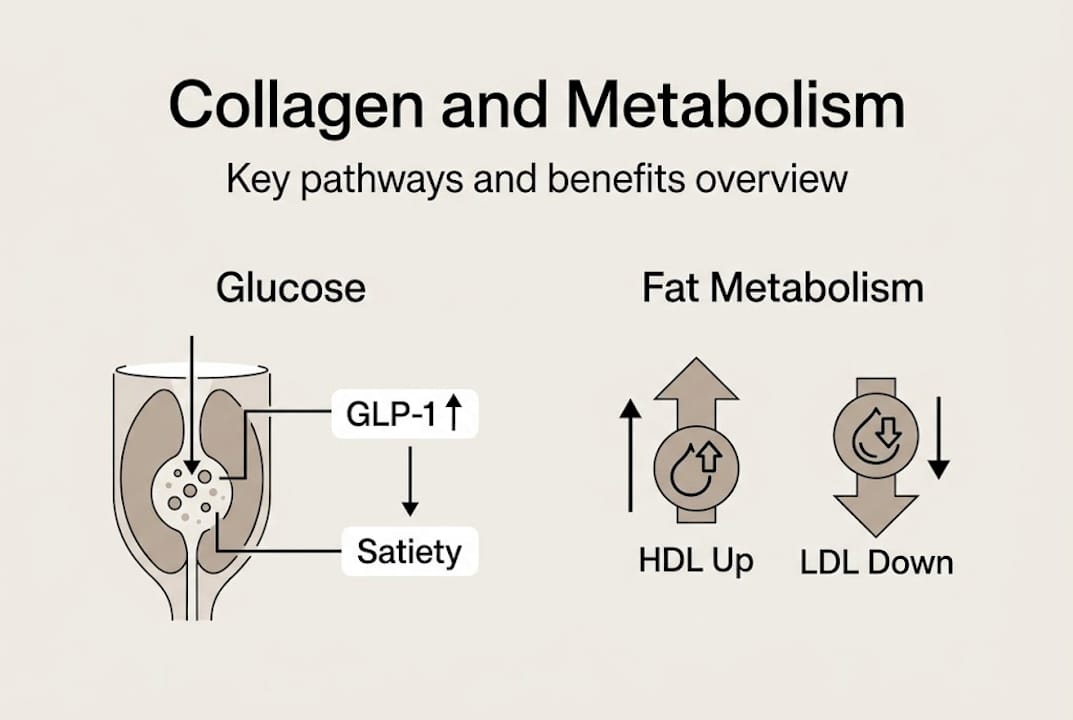
| Metabolic pathway | Collagen peptide effect | Outcome |
|---|---|---|
| GLP-1 secretion | Increased | Greater satiety, better glucose control |
| DPP-IV inhibition | Enzyme blocked | Prolonged GLP-1 activity |
| AMPK activation | Upregulated | Enhanced fat oxidation |
| PPAR-alpha activation | Stimulated | Increased fatty acid burning |
| Lipid profile | HDL up, LDL/TG down | Improved cardiovascular markers |
Pro Tip: Pairing collagen with a small amount of carbohydrate may enhance GLP-1 release and improve the satiety effect. A sachet with a piece of fruit post-workout is a practical way to apply this.
For those interested in collagen for weight loss or collagen’s effect on gut health, these mechanisms provide the biological rationale behind the observed benefits.
What does the evidence really say? Rodents, humans, and the nuances
Here is where honesty matters. The science on collagen and metabolism is genuinely exciting, but the strength of evidence varies considerably depending on whether you are looking at animal or human studies.
Rodent studies: Dramatic results
A rodent meta-analysis found that collagen peptides significantly reduce body mass (SMD of 1.87), food intake (SMD of 1.43), and glucose metabolism markers (SMD of 2.21). Adipose tissue, LDL cholesterol, and triglycerides all fell substantially. HDL and adiponectin rose. These are large, consistent effects across multiple studies.
Human studies: More modest and mixed
The picture in humans is less dramatic. In one study of overweight and obese adults, 10g per day of porcine collagen peptides for four weeks did not reduce daytime glucose levels but did increase glycaemic variability, postprandial glucose, fasting insulin, and HOMA-IR. The changes were small and of limited clinical relevance, but they highlight that collagen is not a straightforward blood sugar solution for everyone.
| Study type | Key findings | Reliability |
|---|---|---|
| Rodent meta-analysis | Large improvements in weight, glucose, lipids | High in animals |
| Short-term human trials | Modest or mixed metabolic changes | Moderate, needs longer trials |
| Skin and joint human RCTs | Consistent improvements | Stronger evidence base |
- Results in humans depend heavily on dose, collagen type, and duration
- Co-factors like vitamin C and calcium amplify outcomes
- Exercise combined with collagen supplementation shows better results than supplementation alone
- Long-term human trials on metabolic outcomes remain limited
Pro Tip: Do not dismiss collagen based on one neutral study. Context matters enormously. A sedentary individual with poor diet will see different results than an active person using collagen strategically alongside exercise and a nutrient-rich diet.
For a deeper look at how the body processes collagen, collagen peptide absorption explains the digestion and bioavailability mechanisms that influence outcomes. Harvard’s expert review echoes this nuanced position.
The real-world benefits: Metabolism, joint, and beauty outcomes you can expect
Setting aside the mechanistic detail, what can you realistically expect from consistent collagen supplementation? Here is an honest summary based on the current evidence.

Skin and connective tissue (strongest evidence):
Hydrolysed collagen peptides absorbed as di- and tripeptides signal fibroblasts to upregulate collagen types I and III, increase hyaluronic acid production, and inhibit matrix metalloproteinases (enzymes that break down collagen). The result is measurable improvement in skin elasticity, hydration, and texture. Joint function and exercise recovery also benefit, particularly when vitamin C is present.
Bone and muscle (good evidence with co-factors):
Collagen supplementation enhances bone mineral density at the femoral neck and spine (SMD of 0.40 to 0.58) and improves muscle performance (SMD of 0.60), especially when combined with calcium and vitamin D. For athletes and older adults, this is a meaningful combination.
Metabolic and body composition outcomes (promising but variable):
- Satiety and appetite control may improve with consistent use
- Fat oxidation markers show positive trends, particularly in studies using higher doses
- Blood sugar and lipid improvements are more reliable in animal models than human trials
- Results are most consistent when collagen is part of a broader nutrition strategy
Statistic: Studies show collagen peptide supplementation can improve muscle performance with an SMD of 0.60, a clinically meaningful effect for athletic recovery.
For those focused on bone health supplements, the combination of collagen with calcium and vitamin D is particularly well supported. You can also explore how to boost bone strength and the role of bone health nutrition in a complete protocol.
How to use collagen for metabolism: Practical tips and caveats
Knowing the science is one thing. Applying it effectively is another. Here is a practical framework for getting the most from collagen supplementation.
Who is most likely to benefit:
Older adults, athletes with high training loads, people managing joint discomfort, and individuals with skin concerns are the most consistent beneficiaries. Those with metabolic conditions may see modest additional support, though collagen should complement rather than replace medical management.
A practical protocol:
- Choose hydrolysed collagen peptides. These are broken down for better absorption and bioavailability compared to whole collagen or gelatin.
- Aim for 10 to 20g per day. Most human studies fall within this range. Higher doses are not necessarily better but may be appropriate for athletes.
- Add vitamin C. Collagen synthesis requires vitamin C as a co-factor. Without it, even high-quality supplementation may underperform.
- Stack with calcium and vitamin D for bone and muscle goals. The evidence for this combination is particularly strong.
- Time it around exercise. Taking collagen 30 to 60 minutes before training may enhance its uptake into connective tissue during the repair window.
- Be patient. Skin and joint outcomes typically require 8 to 12 weeks of consistent use. Metabolic changes, if they occur, may take longer to become apparent.
In animal models, collagen peptides at 400mg per kg per day for four weeks reduced blood glucose and lipids, improved insulin resistance, and raised serum GLP-1 levels. These findings inform the direction of human dosing research, even if direct translation is not yet confirmed.
Pro Tip: Consistency beats intensity with collagen. A daily 10g sachet taken reliably for three months will outperform sporadic high-dose use every time.
For those interested in the broader picture, collagen for gut and metabolic health covers how collagen supports the gut microbiome and inflammatory pathways that also influence metabolic outcomes.
The uncomfortable truths: What most guides don’t tell you about collagen and metabolism
Here is what the supplement industry rarely admits: most of the dramatic metabolic data comes from rodent studies. Mice are not small humans. Their metabolic rate, gut microbiome, and hormonal environment differ substantially from ours. When you see a headline claiming collagen slashes body fat or reverses insulin resistance, check whether the study was conducted in animals or people.
That does not mean collagen is overhyped for metabolism. It means the story is more nuanced than most marketing suggests. The mechanisms are real. The human evidence is early but promising. And supplement quality matters enormously. A low-dose, poorly absorbed product will not replicate the results from a well-designed clinical trial.
We believe collagen works best as part of a whole-health strategy. Pair it with exercise, adequate protein, vitamin C, and sleep. Do not treat it as a shortcut. The collagen and weight loss science supports a supporting role, not a starring one. That honest framing is what separates effective supplementation from wishful thinking.
Find your collagen fit: Targeted supplements for your metabolic and beauty goals
If you are ready to put the science into practice, product quality is the starting point. Dosing accuracy, hydrolysation quality, and added co-factors like vitamin C make a real difference to the outcomes you experience.
KUDU Nutrition’s 20g liquid collagen protein sachets deliver a clinically relevant dose in a convenient, great-tasting format, certified by Informed Sport for purity and consistency. Each sachet aligns with the 10 to 20g daily range supported by current research. Whether your goal is better skin, stronger joints, improved recovery, or metabolic support, our collagen protein supplements range makes daily habit-building straightforward. Explore sampler packs to find your preferred format before committing to a subscription.
Frequently asked questions
Does collagen really improve metabolism?
Collagen peptides may modestly improve metabolism through satiety, GLP-1 secretion, and fat oxidation, but robust, large-scale human evidence is still developing and results vary by individual context.
What dose of collagen is optimal for metabolic health?
Most studies use 10 to 20g per day of hydrolysed collagen peptides, with outcomes generally enhanced when paired with vitamin C or vitamin D depending on your specific goals.
Is collagen more effective for skin and joints or for metabolism?
Skin elasticity and joint recovery have the strongest and most consistent evidence base; metabolic effects are biologically plausible and promising but remain more variable in human trials.
Are all collagen supplements equally effective?
No. Look for hydrolysed collagen peptides at a proven dose of 10 to 20g, ideally with added vitamin C or calcium and vitamin D, and choose products with third-party quality certification for reliable results.