


TL;DR:
- Peptides are short chains of amino acids, while proteins are longer chains with complex structures, affecting their absorption and function. Consuming hydrolyzed collagen peptides can support skin elasticity, hydration, and joint health through efficient absorption and cellular stimulation. Choosing transparent, research-backed supplements ensures efficacy and safety in achieving wellness goals.
Most people assume peptides and proteins are interchangeable. They are not. The distinction is not just academic; it shapes how your body absorbs a supplement, whether a cosmetic ingredient actually reaches your skin, and how a regulatory body classifies a product. Understanding what protein peptides are, how they differ from whole proteins, and what the evidence genuinely says about their benefits gives you a real advantage when navigating the crowded world of collagen supplements, beauty serums, and recovery products.
Table of Contents
- Peptides and proteins: What’s the difference?
- How do protein peptides work in the body?
- Benefits of protein peptides: What does the evidence say?
- Common peptide misconceptions and how to choose wisely
- Why peptide definitions matter more than you think
- Discover collagen peptides for your wellness goals
- Frequently asked questions
Key Takeaways
| Point | Details |
|---|---|
| Peptides vs proteins | Peptides are short chains of amino acids, while proteins are much longer, and this matters for product labelling and use. |
| Bioavailability challenges | Many peptides are not easily absorbed when taken orally, so product formulation is crucial. |
| Evidence-based benefits | Clinical studies support collagen peptides for joint and skin health improvements. |
| Choose quality carefully | Not all peptides are equal—always check scientific backing and quality standards. |
Peptides and proteins: What’s the difference?
First, let’s tackle the core question: how are protein peptides different from proteins?
At the most fundamental level, both peptides and proteins are chains of amino acids linked together by peptide bonds. The critical variable is length. Short chains are peptides; longer chains are proteins. This sounds simple, but the line between them carries significant consequences in science, regulation, and commerce.
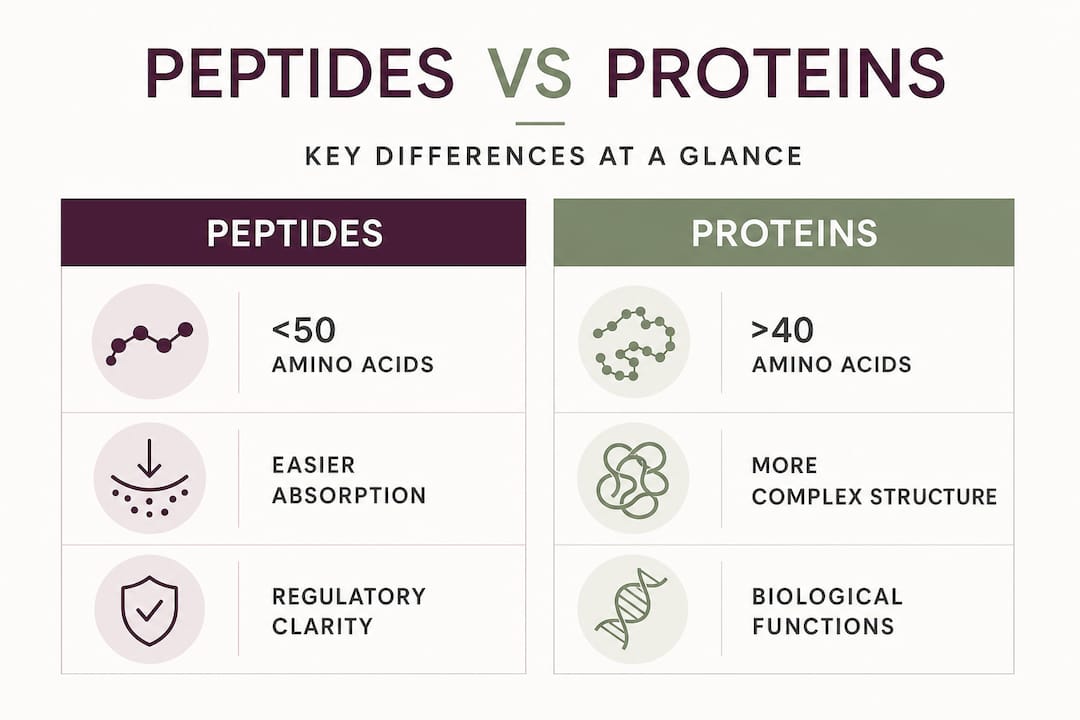
In everyday biology, scientists typically call a chain a peptide when it contains fewer than 50 amino acids, though this threshold can vary between textbooks and research contexts. Proteins are considerably longer, often folding into complex three-dimensional structures that determine their function. Haemoglobin, collagen, and insulin receptors are proteins. Glutathione, a powerful antioxidant found naturally in cells, is a tripeptide — just three amino acids long.
The regulatory world is more precise. In the FDA’s framework, proteins are defined as alpha amino acid polymers with a specific defined sequence greater than 40 amino acids; polymers of 40 or fewer amino acids are classified as peptides. This legal threshold has direct implications for how products are labelled, what health claims manufacturers can make, and which regulatory pathway a new ingredient must follow.
Here is a quick comparison to make this concrete:
| Feature | Peptides | Proteins |
|---|---|---|
| Chain length | Up to 40 amino acids (FDA) | More than 40 amino acids |
| Structure | Linear, minimal folding | Often complex 3D folding |
| Molecular weight | Low | High |
| Digestibility | Rapid, efficient | Slower, more complex |
| Typical supplement form | Hydrolysed collagen, bioactive peptides | Whey, casein, soy protein |
A common misunderstanding is the directional relationship between the two. Peptides can come from proteins — through digestion or hydrolysis — but not all proteins conveniently produce the specific bioactive peptides you are looking for. The sequence of amino acids within the chain determines its biological activity, meaning a randomly digested protein does not necessarily yield the beneficial peptides found in a well-formulated supplement.
This is precisely why understanding collagen peptides benefits matters before you buy. Not every product labelled “collagen” delivers the same peptide profile.
“The terms peptide and protein are often used loosely in marketing, but the distinction in regulatory and scientific contexts carries real weight for product safety, efficacy, and the claims that can legally be made.”
How do protein peptides work in the body?
Now that definitions are clear, let’s examine what actually happens when you consume protein peptides.
When you swallow a collagen supplement, the journey from sachet to bloodstream is not straightforward. Your digestive system is a formidable environment, and many orally consumed compounds simply do not survive the trip intact. Stomach acid and digestive enzymes like proteases actively break down larger molecules, which is both useful and limiting.
The good news for smaller peptides is that they can be absorbed more efficiently than intact proteins. Di-peptides (two amino acids) and tri-peptides (three amino acids) have dedicated transport mechanisms in the intestinal wall, specifically a transporter called PepT1, which shuttles them directly into the bloodstream without requiring further digestion. Larger peptides face more obstacles, including the mucus layer lining the gut and the epithelial barrier itself.
Oral delivery of peptide ingredients is often limited by biological barriers, such as mucus and epithelial barriers, alongside degradation by digestive enzymes, so formulation and delivery strategies matter significantly for how much of a peptide actually reaches systemic circulation. This is the core reason why the form of your supplement matters as much as the ingredient list.
Hydrolysed collagen is the most relevant example here. Hydrolysis is the process of using water, heat, or enzymes to break a larger collagen protein into smaller, more absorbable peptide fragments. When collagen is hydrolysed properly, the resulting peptide fragments, particularly di- and tri-peptides, can pass through the intestinal wall, enter circulation, and travel to target tissues including skin, cartilage, and connective tissue. Understanding the full collagen digestion process helps clarify why product quality is not a minor detail.
Here is how effective absorption tends to occur, step by step:
- Ingestion: You consume a hydrolysed collagen supplement in liquid or powder form.
- Gastric phase: Stomach acid and pepsin begin breaking down any remaining larger fragments.
- Intestinal phase: Pancreatic proteases continue digestion; smaller di- and tri-peptides are selectively transported through PepT1.
- Circulation: Bioactive peptides, including hydroxyproline-containing fragments specific to collagen, enter the bloodstream.
- Tissue delivery: Peptides accumulate in skin dermis, cartilage, and tendons, where they can stimulate fibroblasts and chondrocytes to produce new collagen.
- Biological activity: Target cells respond by upregulating their own collagen synthesis, improving structural integrity over time.
Pro Tip: Choose a liquid collagen supplement over a capsule when possible. Liquid formulations often mean the peptides are already in a partially broken-down form, reducing the burden on your digestive system and improving the speed of absorption.
Benefits of protein peptides: What does the evidence say?
With the science of absorption in mind, let’s see what research says about real-world benefits.
The strongest evidence for protein peptides in wellness focuses on two areas: skin health and joint support. Both have accumulated enough human trial data to move beyond the realm of promising theory.
Joint health and mobility
For joint support, human randomised trials have tested specific hydrolysed collagen products and measured statistically significant improvements in osteoarthritis pain and physical function. This is meaningful because osteoarthritis involves the gradual degradation of cartilage, which is largely made of type II collagen. By providing the specific peptide building blocks that chondrocytes need, collagen supplementation can support the repair cycle from the inside out.

The mechanism here is two-fold. First, collagen-derived peptides serve as substrates, the raw materials for rebuilding cartilage matrix. Second, certain peptide sequences appear to have signalling effects, acting like messengers that tell cartilage cells to increase their own collagen production. This dual action is what separates targeted peptide supplementation from simply eating more protein.
Skin elasticity and hydration
For skin, the evidence is similarly encouraging. Collagen peptide supplementation supports dermal collagen density, skin hydration, and measurable improvements in elasticity after consistent use over eight to twelve weeks. As we age, the body’s natural collagen synthesis declines at roughly one per cent per year from the mid-twenties onwards, making supplementation increasingly relevant as you get older.
Key benefits supported by research include:
- Reduced joint discomfort: Particularly relevant for active individuals, athletes, and those managing early-stage joint wear.
- Improved skin hydration: Peptides support the skin’s ability to retain moisture at a dermal level, not just on the surface.
- Enhanced skin elasticity: Fibroblast stimulation encourages a firmer, more resilient skin structure.
- Faster recovery from exercise: Collagen supports tendons and ligaments, which are often the limiting factor in training recovery.
- Bone density support: Collagen makes up roughly 30 per cent of bone matrix, and peptide supplementation may contribute to long-term bone health.
For a broader picture of how these mechanisms connect, exploring collagen for skin and joints provides a helpful overview of the research landscape.
It is worth noting that consistency matters enormously. Sporadic supplementation is unlikely to produce the cellular signalling effects that drive collagen remodelling. If you are curious about timing and dosage, a practical guide on how to take collagen peptides covers optimal protocols.
Key stat: Some trials report meaningful improvements in joint pain scores and skin hydration measures within 8 to 12 weeks of daily hydrolysed collagen supplementation at doses of 10 to 20 grams per day.
Common peptide misconceptions and how to choose wisely
Knowing the benefits, it is crucial to recognise some common pitfalls and hype when shopping for peptides.
The word “peptide” has become a marketing magnet. You will find it on supplement tubs, luxury skincare ranges, and even functional foods. The problem is that headlines about “peptides” can blur together widely different molecules: food-derived bioactive peptides, prescription drug peptides such as GLP-1 agonists, and synthetic research chemicals used in laboratory settings. These are fundamentally different products with entirely different safety profiles, regulatory oversight, and evidence bases.
A consumer reading about “peptides improving metabolism” in a medical news story might reasonably assume that their collagen sachet offers the same effect. It does not. Conflating these categories leads to either inflated expectations or unnecessary concern.
Here is what to look for when evaluating a peptide supplement:
- Source transparency: The product should clearly state whether it uses bovine, marine, or porcine collagen, and ideally the specific peptide profile.
- Hydrolysis confirmation: Look for “hydrolysed collagen” or “collagen peptides” explicitly, not just “collagen protein,” to ensure bioavailability.
- Dose per serving: Research supporting joint and skin benefits generally uses 10 to 20 grams per day. Single-gram doses found in some beauty drinks are unlikely to deliver comparable results.
- Third-party certification: Certifications like Informed Sport indicate the product has been tested for banned substances and label accuracy.
- Clinical backing: Some manufacturers can point to specific peptide sequences, such as FORTIGEL or VERISOL, that have their own human trial data. This level of specificity is a positive sign.
- Regulatory compliance: In the UK, food supplements must comply with FSA guidelines. Products making medicinal claims without proper authorisation are a red flag.
Understanding why collagen is important for your health can also help you cut through the noise and focus on what actually matters in a formulation.
Pro Tip: If a peptide product does not disclose the collagen source, the degree of hydrolysis, or the amino acid profile, treat it as a warning sign. Transparent brands are confident in their formulations.
Why peptide definitions matter more than you think
Stepping back, here is a perspective you will not hear from most supplement brands or beauty shops.
The industry tends to use “peptide” as a synonym for “advanced” or “premium.” A product labelled with peptides is assumed to be more sophisticated than one that simply says protein. But this framing is misleading, and in some cases, it actively harms consumers.
Here is the uncomfortable truth: the regulatory definition of peptides varies by jurisdiction and context, meaning a product marketed as a “peptide supplement” in one country might be classified differently, and held to different safety standards, in another. This regulatory inconsistency means that the burden of evaluation falls on you, the consumer, rather than on a harmonised global standard.
When brands lean into the peptide label without explaining what type of peptide, what dose, what molecular weight, or what research supports it, they are exploiting definitional ambiguity rather than clarifying it. We believe this is genuinely worth being angry about.
The counter-intuitive insight here is that a clearly labelled “hydrolysed collagen protein” product with published amino acid data might actually be more trustworthy than a sleekly marketed “advanced peptide complex” with no specifics. Less jargon and more data is almost always a better sign.
If you want to understand how specific bioactivity works in practice, exploring collagen bioactivity for health and recovery offers a grounded look at what the science actually supports. The brands worth trusting are the ones who point you towards that kind of evidence rather than away from it.
Discover collagen peptides for your wellness goals
Ready to apply what you have learned? Make your next health step a practical one.
At KUDU Nutrition, we built our collagen supplements around the science covered in this article: hydrolysed collagen peptides at a meaningful dose, with full ingredient transparency and Informed Sport certification. Each sachet in our 20g collagen protein range delivers 20 grams of hydrolysed collagen peptides in a format your body can absorb efficiently without the guesswork.

If you want to understand more about how collagen peptides support skin, beauty, and long-term wellness before committing, our collagen and beauty info page covers the essentials clearly. When you are ready to get started, our try collagen protein pack is the most effective way to experience consistent results over a meaningful trial period. No bluster, just science-backed nutrition designed to work with your body.
Frequently asked questions
Are all peptides the same in supplements?
No. Peptide supplements vary by source, sequence, size, and quality, so choosing products with transparent, research-backed formulations is essential for predictable results.
Do collagen peptides really help with joints?
Yes. Randomised, controlled trials report statistically significant improvements in joint pain and physical function after consistent daily collagen peptide supplementation, making them a credible addition to a joint health strategy.
Is it possible to get protein peptides just from diet?
You can obtain small peptides from protein-rich foods such as meat, fish, and eggs, but the concentrated hydrolysed collagen peptide profiles found in supplements are unique to targeted supplementation and difficult to replicate through diet alone.
Are protein peptides safe to take long term?
Research consistently suggests that collagen peptide supplements are safe for healthy adults when taken at recommended doses. Human clinical trials report a strong safety profile alongside measurable efficacy for both skin and joint outcomes.